


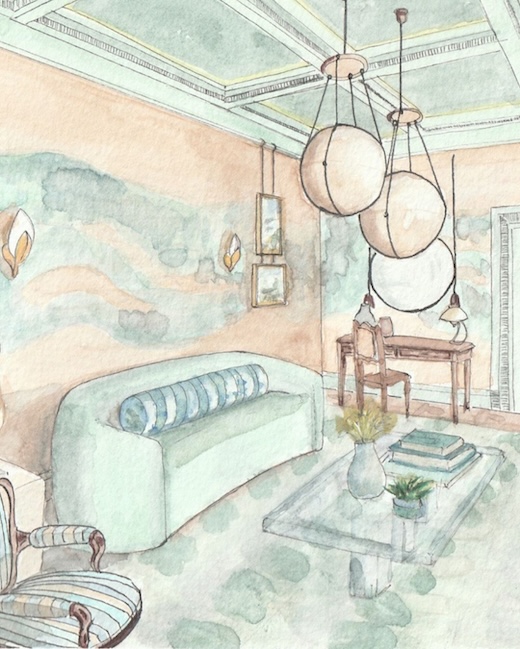
Inside the Phillip Jeffries Morning Room by Sara Cosgrove Studio
In celebration of WOW!house, we sat down with interior designer Sara Cosgrove, of Sara Cosgrove Studio, to discuss her thoughtfully conceived Morning Room – a space described as a “quiet, uplifting analogue sanctuary.”
Known for her refined, deeply considered interiors, Sara’s work is rooted in materiality, craftsmanship and a strong sense of narrative. Her contribution to this year’s WOW!house is no exception: a room designed to slow the pace, invite reflection and create a sense of calm through layered textures and subtle detail.
We were proud to be involved in bringing this vision to life, installing specialist wallcoverings by Phillip Jeffries – where precision and time-honed expertise were essential to achieving the impactful finish the scheme demands.
Here, Sara shares the thinking behind the space, her approach to timeless design, and why craftsmanship remains at the heart of everything she does…

The Morning Room has been described as a “quiet, uplifting analogue sanctuary.” Can you tell us about the story behind the space and how that concept evolved?
“The starting point was a reaction to how we live now – constant noise, digital saturation, and very little true pause. I wanted to create a space that felt deliberately slower. The idea of an “analogue sanctuary” came from stripping things back to tactile, sensory experiences -natural light, texture, material, and stillness. It evolved into a room that doesn’t demand attention but rewards it – where every element earns its place.”
What does the idea of a “Morning Room” mean to you in a contemporary context, and how did you reinterpret it for WOW!house?
“Traditionally, a morning room was about light and ritual – spaces designed for reading, reflection, and quiet beginnings. In a contemporary context, that feels more relevant than ever. For WOW!house, I reinterpreted it as a space for intentional living, less about function, more about feeling. Anchored by the Victoria Stone fireplace, it becomes a place to pause, reset, and reconnect.”
If you had to describe the emotional experience of stepping into the Morning Room in just three words, what would they be?
“Playful, Intriguing, Restorative.”
Your work often celebrates craftsmanship and materiality – how did those principles influence your design for this room?
“Materiality was the foundation. The wall palette – layered through Phillip Jeffries Aura and Phillip Jeffries Sutton Weave – creates a quiet depth that shifts with the light throughout the day. But that level of refinement only works when the execution is flawless. The wallpaper installation requires exceptional skill – the precision of the hanging, the alignment of textures, and the consistency across surfaces are what allow the materials to read as seamless and architectural.”
What drew you to collaborate with Phillip Jeffries on this space, and how did their materials help bring your vision to life?
“Phillip Jeffries understands materiality at a very refined level, I was absolutely delighted to collaborate with such a universally respected company. Their wallcoverings really stand apart in terms of the unusual mix of textures high gloss grounded with this wonderful polished plaster like matte backdrop. The combination of Phillip Jeffries Aura and Phillip Jeffries Sutton Weave allowed us to build layers of softness and tonal variation.”
When working with specialist wallcoverings, how important is the installation process in achieving the final result?
“It’s everything. With high-end wallcoverings, there is no margin for error. The craftsmanship of the wallpaper hanging company is critical – alignment, pattern continuity, tension, and finish all have to be exact. In this room, their level of skill is what transforms beautiful materials into a fully resolved space.”
Are there particular details or moments within the room where craftsmanship
and precision were especially critical?
“The junctions – where materials meet – are always the most demanding. Transitions between the wallcoverings, joinery, and architectural elements had to be handled with absolute accuracy. Alongside that, moments like the clarity of the Pure White Lines perspex coffee table against the softness of the Top Floor rug, or the positioning of the Fiona McDonald mirror, rely on precision to feel effortless.”
You speak about creating spaces of enduring beauty – what does “timeless design” mean to you today?
“Timeless design isn’t about avoiding trends, it’s more about being honest in your approach to them. Let’s say Bouclé, it’s a wonderful, timeless, practical fabric, but suddenly it becomes ubiquitous and loses its appeal. For me timeless design comes down to proportion, material integrity, and clarity of concept – something that feels fresh but not provocative. A good example of this at Wow!House are the Kassavello sofa a classic style within a more contemporary space anchors the room without dating it. It also goes without saying if the craftsmanship isn’t there, the design won’t endure.”
You’re known for creating calm, beautifully balanced interiors – what are the key principles you return to when designing a space?
“Every scheme begins with a deep understanding of how the space needs to perform – operationally, and emotionally before a single material is considered. I focus on building a strong conceptual framework often inspired by a piece of art, a story or fashion, then layering in texture, materiality, and detail to create depth without excess. The result is an environment that feels effortless but is highly resolved, where every element has purpose.”
Are there any standout projects in your portfolio that have particularly shaped your approach to design or pushed your creativity in new directions?
“Working on Dromoland Castle has been an exercise in balancing heritage with contemporary expectation. The project demands a considered approach, respecting the building’s architectural legacy while quietly elevating the guest experience through refined detailing and layered interiors. Every decision is anchored in authenticity, with materials, craftsmanship, and spatial planning working together to create a sense of storytelling that feels both timeless and relevant.”

To discover more, visit Sara Cosgrove.